Every Week You Don't Collect a Draw Is a Week You're Funding Someone Else's Pool.
WFP's construction cash flow management software gives you per-project financial visibility, gamified draw collections that turn your PMs into active collectors, and cost-category analysis that shows exactly where money is made and lost on every build. No more asking the office manager for a spreadsheet. No more guessing whether you are profitable or just busy.
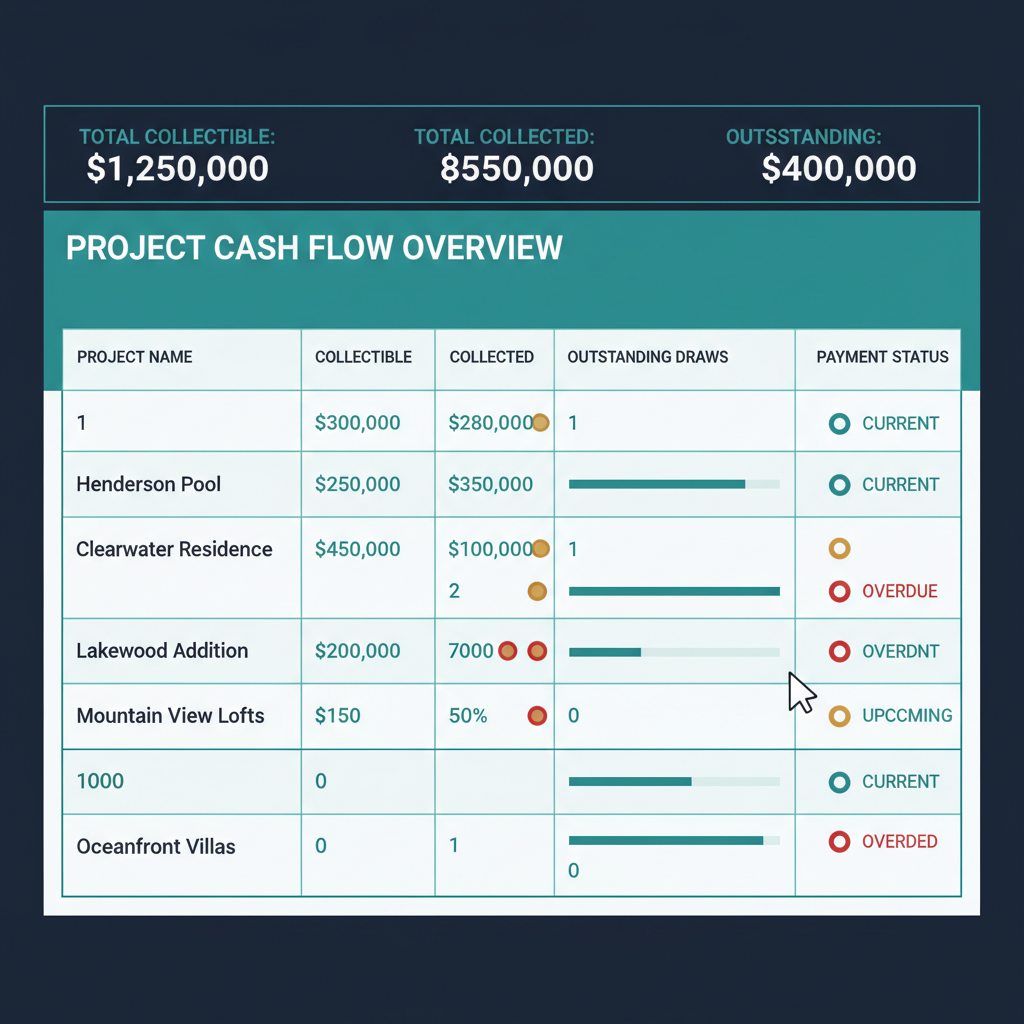
It's Friday Afternoon. Do You Know How Much Money Is Sitting Uncollected Across Your Projects?
It is 4:30 PM on a Friday. Marcus has 28 active projects. His office manager just left for the weekend. He wants to know one thing: how much money should have been collected this week that was not. He cannot answer that question. The draw schedule for the Henderson project hit its milestone two weeks ago but nobody sent the invoice because the PM did not flag it. The Clearwater project has a $45,000 draw that the customer has been sitting on for 11 days — Marcus does not know this because the payment status lives in a spreadsheet only the office manager updates on Mondays.
Meanwhile, a material supplier invoice for the Lakewood project is due Tuesday and there is not enough in the operating account because three draws that should have been collected are still outstanding. Marcus opens QuickBooks. It tells him total accounts receivable. It does not tell him which projects have draws that passed their milestone trigger. It does not tell him which PMs committed to collecting this week and which ones forgot.
He calls his office manager. She does not answer — it is Friday at 4:30.
This is what construction financial management looks like when your money tools were not designed for construction. Here is what it looks like when they are.
The Solution
From Financial Guesswork to Complete Cash Flow Clarity — Every Dollar, Every Project, Every Week
WFP does not just track construction finances. It transforms how construction companies see, collect, and analyze their money — with construction-specific workflows that accounting software cannot replicate.
Every Project's Financial Picture. One Screen.
The cash flow dashboard shows collectible amounts, collected amounts, outstanding draws, and payment timelines for every active project simultaneously. Color-coded indicators highlight money coming this week (green), next week (default), and overdue (red). Marcus opens one screen on Monday morning and sees exactly where his cash position stands across all 28 projects — no phone calls, no spreadsheet requests, no Friday afternoon panic.
Collections That Move — Because Your Team Is Watching
This is not a report. It is an accountability engine. PMs commit to weekly collection targets for their assigned projects. As draws move from "collectible" to "collected," the dashboard updates in real time — visible to the entire team. When Jessica collects the Henderson draw she flagged on Tuesday, the number moves. When the Clearwater draw stays outstanding for another week, that is visible too. Collections become a team effort with transparent accountability, not a black box the office manager handles alone.
Milestone-Based Draws That Never Slip Through the Cracks
Every project has a draw schedule tied to construction milestones — not arbitrary invoice dates. When the shell phase is complete, the corresponding draw becomes collectible automatically. PMs see which draws are ready to send, which have been sent, and which are overdue. No more missed milestones sitting idle because nobody tracked the trigger. The draw does not wait for someone to remember — the system surfaces it the moment the milestone condition is met.
Is Project #23 Making Money? Now You Know.
Configurable cost categories — permitting, shell, hardscapes, interior finishes, equipment, labor, materials — give owners granular profitability analysis per project. Compare estimated costs against actual costs in real time as the project progresses. Marcus does not need to wait until a project closes to discover it lost money on hardscaping. He sees the variance developing while there is still time to adjust.
The Numbers That Actually Matter to a Builder
Aggregate financial views across all projects, by PM, by territory, by project type, or by time period. See total collectible, total collected, total outstanding, and collection velocity trends. Export for your accountant or CPA. But more importantly — use it internally to understand which PMs collect fastest, which project types are most profitable, and where cash flow bottlenecks consistently form.
The Difference
What QuickBooks, Spreadsheets, and Generic Construction Software Cannot Do
Gamified Collections with Team Accountability
QuickBooks tracks invoices. Buildertrend tracks payments. Neither turns draw collection into a visible, accountable team process. WFP's gamified collections dashboard makes every PM responsible for their project collections with targets, real-time tracking, and company-wide visibility. This is the difference between "we sent an invoice" and "we collected the money."
Milestone-Triggered Draws, Not Calendar-Based Invoices
Generic financial tools invoice on dates. Construction collects on milestones. WFP's draw schedule is tied to construction phase completion — when the shell is done, the draw surfaces automatically. No manual tracking of which projects hit which milestones. No draws sitting idle because someone forgot to check the production schedule against the payment schedule.
Per-Project Cost Category Analysis
QuickBooks gives you company-wide P&L. It does not tell you that Project #23 is losing money specifically on hardscaping while Project #47 is 12% over budget on materials. WFP's configurable cost categories deliver per-project profitability analysis with the granularity builders actually need — not just "how much did we spend" but "where exactly are we bleeding."
Financial Data Embedded in the Operating System
Sage and Knowify are standalone financial tools. They do not know which phase a project is in, who the PM is, whether the sub compliance is current, or when the next inspection is scheduled. WFP's financial layer is embedded inside the construction operating system — financial data lives alongside project data, sub data, customer data, and scheduling data. One system, one reality.
A Construction Company Reduced Operational Overhead by an Estimated 30% — Starting with How They Collected Money
When every draw is tied to a milestone, every collection is tracked in real time, and every PM sees exactly what they need to collect this week, money stops sitting idle. A construction company managing 60+ simultaneous projects estimated a 30% reduction in operational overhead after implementing financial visibility across every active build. The difference was not a new accounting system — it was a construction operating system that made financial clarity part of daily operations, not a monthly reconciliation exercise.
When PMs actively drive collections instead of waiting for the office to chase payments, the entire cash flow cycle accelerates. Draws that used to sit for weeks get collected in days.
FAQ
Common Questions About Construction Financial Management in WFP
Can't find your answer? Ask us in a demo
WFP's cash flow dashboard shows collectible, collected, and outstanding amounts for every active project in one view. Color-coded indicators flag overdue draws and upcoming collection targets. Drill into any project for a full financial breakdown — cost categories, draw schedule, payment history, and profitability analysis. No spreadsheets, no manual aggregation.
Gamified draw collection means your PMs commit to weekly collection targets for their assigned projects. As draws are collected, the dashboard updates in real time — visible to the entire team. It transforms draw collection from a back-office task into a visible team accountability process. PMs see their targets, see their progress, and know the whole organization is watching the same numbers.
WFP handles construction-specific financial management — draws, collections, per-project job costing, cost category analysis, and financial dashboards. It does not replace your general accounting software (QuickBooks, Sage, Xero). WFP gives you the construction financial visibility your accounting software cannot, and your accountant still gets the reports they need via export.
Every project has configurable cost categories — permitting, shell, hardscapes, interior finishes, equipment, labor, materials, and any custom category you define. Estimated costs are set at project creation. Actual costs are tracked as they occur. The variance between estimated and actual is visible in real time, so you catch budget overruns while the project is still in progress — not after it closes.
Yes. The gamified collections dashboard shows collection performance by PM — who committed to what, who collected, and who has outstanding targets. This gives owners direct visibility into collection accountability without micromanaging. It also creates healthy competition among PMs to hit their numbers.
Draws are tied to construction milestones, not arbitrary dates. When a project completes its shell phase, the corresponding draw becomes collectible automatically. PMs see the draw surface in their collection queue without needing to cross-reference a production schedule against a payment schedule. Milestone-based triggers mean you collect when the work is done, not when someone remembers to send an invoice.
WFP is $2,500/month — one price, unlimited users, unlimited projects, full access to all features including the complete financial management suite: cash flow dashboard, gamified collections, draw management, job costing, financial analysis, and reporting. No add-on modules. No per-user fees. See the full pricing breakdown at /pricing.
Explore More of the Platform
See how this feature connects to the rest of the platform.
See How WFP Turns Your Cash Flow from a Guessing Game into a Dashboard
Get a personalized demo showing the cash flow dashboard, gamified collections, per-project job costing, and draw management — tailored to your project volume and financial workflow.
Schedule a DemoUnlimited users. Unlimited projects. One price.