Twenty-Two Active Projects. Do You Know Which Ones Are Waiting on Materials?
WFP tracks material needs, orders, and receipts per project and per project step — so you always know what has been ordered, what has arrived, and what is still missing. Material costs flow directly into job costing and financial dashboards. No more guessing. No more delays from materials nobody ordered.
It's Wednesday Morning. A Crew Is Standing on Site with Nothing to Install.
Jessica gets a call at 7:45 AM from the crew lead on the Bayshore project. The tile crew arrived at 7:00 for a full day of installation, but the waterline tile is not on site. Jessica pulls up her spreadsheet — it shows the tile was supposed to be ordered two weeks ago, but the "ordered" column is blank. She calls the supplier. They have no order on file. The tile has a three-week lead time. The Bayshore project just lost three weeks because of a procurement gap nobody caught.
Meanwhile, on the Riverview project across town, materials arrived yesterday — coping stone and pavers for the deck phase. But the Riverview project is still in the plumbing rough-in phase. The materials are sitting on site, exposed to weather, taking up space the plumbing crew needs, and representing $8,000 in inventory that arrived four weeks too early because nobody coordinated the order timing with the project schedule.
At the office, Marcus asks how much the company has spent on materials this month across all projects. Nobody can answer without pulling invoices from four different suppliers and cross-referencing them against project budgets. The answer comes three days later — and it is $14,000 more than expected.
Material delays cost you time. Material waste costs you money. Both happen because material status is invisible across your projects.
The Solution
Every Material Tracked — From Need to Receipt, Project by Project
WFP tracks the full material lifecycle per project and per step — connecting procurement to the build schedule and financial dashboard.
Define What Every Project Needs — Tile, Coping, Decking, Everything
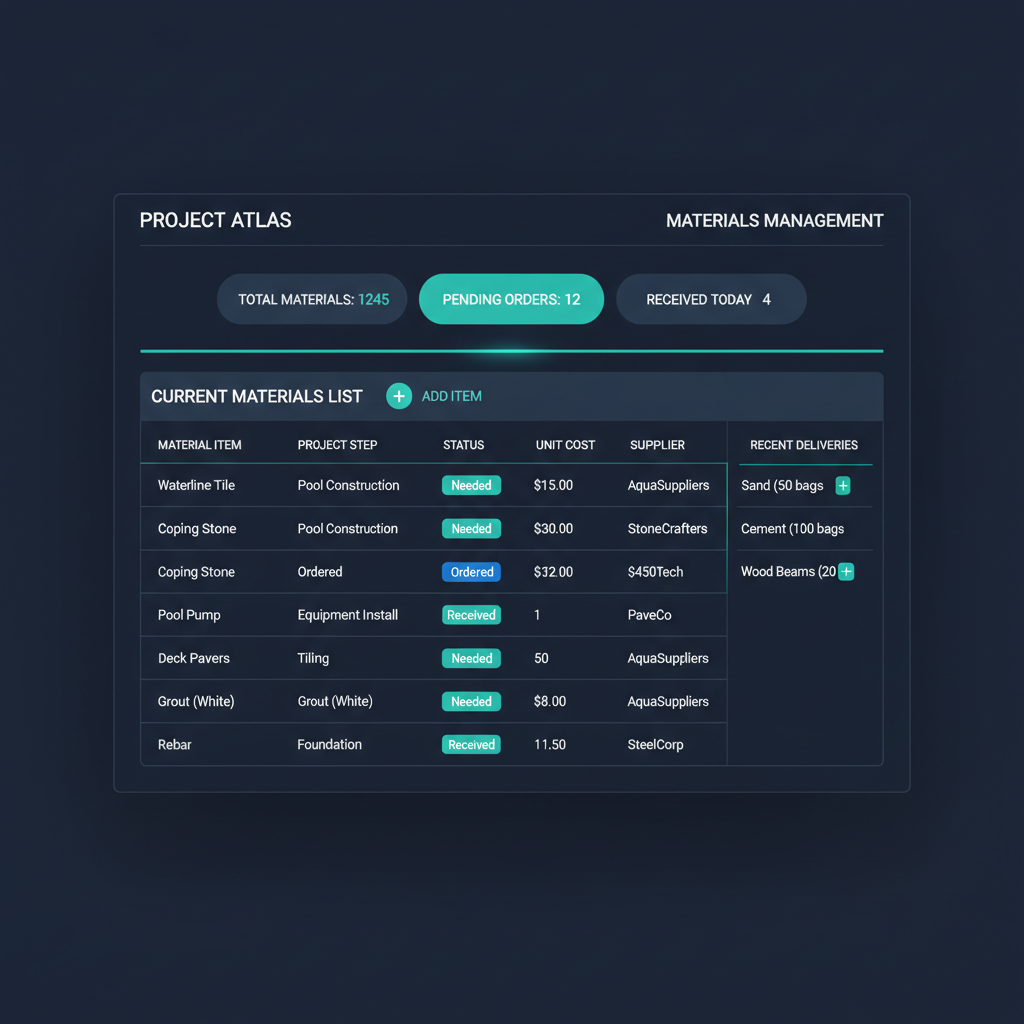
WFP lets you define material needs per project and per project step — tile for the waterline, coping for the deck edge, pavers for the patio, pumps and heaters for equipment installation, and every other material your project requires. Each material need is tagged to a specific project phase so procurement timing aligns with the build schedule. When Jessica looks at a project, she sees exactly what materials are needed, what has been ordered, and what is still outstanding.
Know What Has Been Ordered — and What Has Not
When a material order is placed, the status updates from "needed" to "ordered" with supplier, date, and expected delivery visible to everyone on the project. If the tile for the Bayshore project was never ordered, WFP shows the gap — a "needed" status with no order — before the tile crew arrives to an empty site. PMs and procurement coordinators share the same view of order status across all active projects.
Confirm What Arrived — and Flag What Did Not
When materials arrive on site, WFP captures the receipt: quantity received, date, and any discrepancies (wrong quantity, wrong material, damaged goods). This receiving confirmation closes the procurement loop — material needs that are "ordered" but not yet "received" remain visible as outstanding items. The PM knows exactly what is on site and ready for installation.
Material Costs Connected to Project Steps and Budgets
Every material entry in WFP carries a cost that feeds directly into the project's financial dashboard and job costing reports. Material costs are categorized by project step (permitting, shell, hardscapes, interior finishes, equipment) so Marcus can see not just total material spend, but where the money went on each project. This cost granularity is the foundation of accurate job costing.
See Material Status Across Every Active Project in One View
WFP's materials dashboard shows material status across all active projects — which projects have outstanding material needs, which have orders in transit, and which have received everything they need. This cross-project visibility turns material procurement from a per-project scramble into a coordinated operation. Procurement can batch orders, identify common materials across projects, and prevent the "we ordered the same tile from two different suppliers at two different prices" problem.
The Difference
What Cost Tracking Alone Cannot Tell You
Cost Tracking vs. Procurement Tracking
Buildertrend and JobTread let you budget material costs and track spending against that budget. Neither shows you whether the tile for Project #23 has been ordered, when it is expected, or whether it has arrived on site. The financial number is there. The operational status is not. WFP tracks both — cost and logistics — in one system because they are two sides of the same material.
Per-Step Material Granularity
Generic construction tools track materials at the project level: "total material cost for Project #23." WFP tracks materials per project step — shell materials, hardscape materials, equipment, interior finishes — each with its own need/order/receipt status and cost allocation. This granularity is what makes accurate job costing possible and what prevents the "we are over budget but nobody knows where" conversation.
Cross-Project Material Coordination
When you manage 30+ projects, you are ordering similar materials from the same suppliers across multiple builds. Spreadsheets and project-level trackers do not show you this cross-project pattern. WFP's cross-project material view lets procurement see all outstanding material needs in one dashboard — enabling batch ordering, price negotiation, and elimination of duplicate orders from different PMs ordering the same material independently.
When You Know Exactly What Every Project Needs, Overhead Drops
A construction company managing 60+ simultaneous pool projects estimated a ~30% reduction in operational overhead after adopting the platform. A meaningful portion of that reduction came from procurement efficiency — eliminating rush orders for materials that should have been ordered weeks earlier, preventing duplicate orders across projects, and tracking material costs with granularity that made job costing accurate for the first time. When material procurement is coordinated instead of improvised, the savings are immediate and cumulative.
Most construction companies track materials through a combination of spreadsheets, supplier portals, text messages, and memory. The PM knows what a project needs, places orders by calling suppliers or emailing, and tracks delivery informally. This works at 5 projects. At 20+, the gaps become project delays and cost overruns. WFP centralizes material tracking per project and per step.
Yes. WFP tracks material needs per project step — shell materials, hardscape materials, equipment, interior finishes, and any other category you define. Each material entry carries a need/order/receipt status and an associated cost. This step-level granularity means you know exactly where material spending is allocated within each project.
Material costs in WFP feed directly into the project's financial dashboard and job costing reports. When a material is ordered and its cost recorded, that cost appears in the project's financials under the appropriate step category. This means your job costing reflects actual material expenditures — not estimates or end-of-project reconciliations.
Yes. WFP's materials dashboard shows outstanding material needs, pending orders, and received materials across every active project. Procurement teams can see which projects have material gaps, which orders are in transit, and which projects have everything they need — all from one screen.
No. WFP tracks your material needs and order status — it does not place orders with suppliers directly. You continue ordering through your existing supplier relationships. WFP provides the coordination layer that shows what needs to be ordered, what has been ordered, and what has arrived, so the procurement process is visible and manageable across all projects.
Most material-related delays happen because an order was never placed, placed too late, or placed for the wrong quantity. WFP surfaces these gaps before they become delays — a material need with no order shows up clearly in the project's material list. PMs catch procurement gaps during project review, not when the crew arrives to an empty site.
WFP is $2,500/month — one price, unlimited users, unlimited projects, all features including materials management, financial dashboards, and everything else. No add-ons. See the full pricing breakdown at /pricing.
Explore More of the Platform
See how this feature connects to the rest of the platform.
See How WFP Tracks Every Material Across Every Project in Your Operation
Get a personalized demo showing per-project material tracking, order status visibility, and cost integration — tailored to the materials and suppliers your company works with.
Schedule a DemoUnlimited users. Unlimited projects. One price.